
'In fact, when monetary policy has been deployed, it does not distinguish between types of shocks. It goes straight for the kill.'

Benchmark lending rates unchanged with repo rate at 5.25%
The Reserve Bank of India (RBI) on Friday cut the repo rate by 25 basis points to 6.25 percent, marking the first reduction in five years. The central bank also projected GDP growth for fiscal year 2026 at 6.7 percent and inflation to come down to 4.2 percent in FY26 from 4.8 percent in FY25. The RBI said the global economic backdrop remains challenging but the Indian economy continues to remain strong and resilient.

Even if the Reserve Bank of India's Monetary Policy Committee decided to hold interest rates in the October meeting, it acknowledged the scope for further rate cuts while waiting for the impact of the past steps to play out.
State Bank of India's latest report highlights a 'chalk and cheese' divide in the Reserve Bank of India's recent policy communications, with the Monetary Policy Committee minutes showing a hawkish tone while the Governor's statements are more data-dependent, leading to market uncertainty regarding future interest rate hikes.

Benchmark interest rate hiked by 50 basis points to 3-year high at 5.90 per cent. Economic growth projection for FY23 cut to 7% from 7.2% estimated in August. GDP expected to grow at 6.3% in September quarter, 4.6% each in December and March quarters.
RBI Governor Sanjay Malhotra reiterated India's cautious stance on cryptocurrencies due to concerns over monetary sovereignty and capital flows, while actively promoting underlying technologies like distributed ledger technology and tokenisation. He also addressed the global rise in public debt and hardening bond yields, attributing it to increased government and private spending, including that driven by AI, and noted the implications of global interest rates on India's monetary policy.
The Reserve Bank on Wednesday hiked key benchmark policy rate by 25 basis points to 6.5 per cent, citing sticky core inflation.
The Reserve Bank of India on Wednesday raised its policy repo rate by 25 basis points to 5.50 per cent, beginning a rate-hike cycle as rising inflation risks, elevated global yields and resilient domestic growth strengthened the case for tighter monetary policy. The decision by the Monetary Policy Committee marks a shift from its August policy, when it kept the repo rate unchanged at 5.25 per cent and retained a neutral stance while seeking greater clarity on the inflation outlook and growth-inflation balance.

Declared semi-annually (i.e. March and September), the Monetary Policy takes stock of the economy's liquidity and inflationary conditions and employs the necessary tools to revive it.

'We never waste a crisis. There will be learning and the supervisory tools will get better with each episode.'

The RBI is fully aware that the high-cost loans and high indebtedness of the borrowers could pose financial stability risks, if not addressed by these NBFCs. Governor Shaktikanta Das has issued a stern warning, saying the RBI is closely monitoring these areas and will not hesitate to take appropriate action, if necessary, if the culprits don't opt for self-correction. Watch out for some action, soon, notes Tamal Bandyopadhyay.

His remarks come amid a debate over whether Tata Sons, the holding company of India's largest conglomerate Tata group, is required to go public.

Indian benchmark indices Sensex and Nifty experienced declines in early trade, ending a two-day rally, driven by a spike in Brent crude oil prices above USD 101 per barrel and investor caution ahead of the Reserve Bank of India's monetary policy decision. Track Sensex, Nifty on October 7.

The Reserve Bank of India's Monetary Policy Committee (MPC) has commenced its three-day meeting, with a majority of economists and bankers anticipating a 25 basis point rate hike to counter escalating inflation risks, particularly from West Asia conflicts.

The Reserve Bank of India's Monetary Policy Committee (MPC) has indicated that rate cuts are improbable in the near term, with headline inflation projected to reach 6 per cent in the third quarter. Minutes from the October meeting reveal growing concerns among members about inflation spreading beyond food and fuel, leading to a shift in policy stance towards calibrated tightening.
With inflation comfortably below the Reserve Bank of India's (RBI's) 4 per cent median target and likely to undershoot its 3.7 per cent projection for 2025-26 (FY26), there is room for the monetary policy easing cycle to be sustained, the Finance Ministry said on Monday. The comments, featured in the ministry's Monthly Economic Review for June 2025, assume significance ahead of the Monetary Policy Committee (MPC) meeting of the Reserve Bank of India (RBI) scheduled to begin from August 5.

Analysts predict that the Reserve Bank of India's interest rate decision, crude oil prices, and global bond yields will be the primary factors influencing the Indian stock market this week, alongside macroeconomic data and foreign investor activity.
A 25-basis-point increase would restore some real monetary restraint when expected inflation has risen, liquidity remains easy and growth is strong, points out Amarendu Nandy.
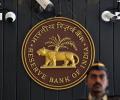
Rs 5,000 crore additional liquidity facility to be provided by the National Housing Bank to boost liquidity in housing sector, the RBI said.
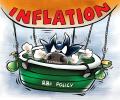
The Reserve Bank of India (RBI) has marginally raised its retail inflation forecast for the current fiscal year (FY27) to 5.2 per cent from 5 per cent, citing increasing price pressures across various commodities. Concurrently, the Monetary Policy Committee (MPC) unanimously decided to hike the key interest rate (repo) by 25 basis points to 5.5 per cent, shifting its stance to 'calibrated tightening'.

Inflows from Europe, falling crude oil to come to the rescue if rupee cracks against the dollar.

The fund said oil prices are still at double the levels recorded in end-2006, even after the 40 per cent fall in prices from the peak they reached in July this year. Food prices too are still above end-2006 levels. Because of this, fuel importing low-income countries will see their import bill increase by 3.2 per cent of their GDP, while food importing countries will spend additional amount equivalent to 0.8 per cent of GDP on food.
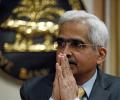
Monetary Policy Committee keeps key interest rate (repo) unchanged at 4% for 7th consecutive time; Consequently, reverse repo rate too remains unchanged at 3.35%; Bank rate also remains same at 4.25%;

Reserve Bank Governor Shaktikanta Das on Friday stressed that the monetary policy must remain actively disinflationary to ensure that the decline in inflation from its peak of 7.44 per cent in July continues smoothly. Addressing the Kautilya Economic Conclave 2023, he also said price stability and financial stability complement each other and it has been an endeavour at RBI to manage both efficiently. Retail inflation declined to a three-month low of 5.02 per cent annually in September on account of moderation in vegetables and fuel prices, and was back within the Reserve Bank's comfort level.

Indian benchmark indices Sensex and Nifty experienced declines in early trade, influenced by the Reserve Bank of India's (RBI) recent repo rate hike and its signal for continued monetary tightening, coupled with rising crude oil prices and foreign fund outflows. Track Sensex, Nifty on October 8.

The RBI has cut key rates to boost the economy.

India's economy is projected to lose momentum in the second half of fiscal 2026-27, with tighter financial conditions, elevated energy prices, and broadening inflation pressures posing significant risks, according to DBS Bank economist Radhika Rao.

Indian stock markets are set to be influenced this week by a confluence of factors including quarterly corporate earnings, the US Federal Reserve's interest rate decision, fluctuations in crude oil prices, and ongoing geopolitical developments in West Asia.
The Reserve Bank of India (RBI) on Friday kept key repo rate unchanged at 4 per cent in view of rising inflation and faint signs of economic growth amid gradual lifting of coronavirus (COVID-19) lockdown. The central bank's newly-constituted monetary policy committee (MPC) began its three-day meeting on October 7 and maintained the stance as accommodative. It also kept the reverse repo rate unchanged at 3.35 per cent.

India's wholesale price-based inflation (WPI) increased to 9.92 per cent in August, up from 9.78 per cent in July, primarily due to rising prices across food, manufactured items, and fuel and power sectors.

Analysts predict that developments in the West Asia conflict, crude oil prices, and upcoming US inflation data will be the primary factors influencing the Indian stock market next week, alongside foreign investor activity and global market trends.

RBI Governor Sanjay Malhotra stated that the central bank is closely monitoring whether the supply shock from the West Asia conflict will lead to a generalised price rise, potentially necessitating monetary policy action.
Economists widely anticipate the Reserve Bank of India's Monetary Policy Committee will increase the repo rate by 50 basis points, likely split between the October and December meetings, as retail inflation is projected to peak at 6.1 per cent in the third quarter, exceeding the RBI's tolerance limit.

"Pressure on the current account is a temporary problem. Sooner rather than later, our external sector will improve," said RBI Governor Sanjay Malhotra.

New dates to be announced shortly, the RBI said.

The Reserve Bank of India (RBI) has increased its GDP growth forecast for the current fiscal year (FY27) by 40 basis points to 7.1 per cent, acknowledging the resilience of domestic economic activity despite global headwinds and geopolitical tensions.

Subbarao's annual statement will be of unusual interest this year

India's wholesale price-based inflation surged to 11.39 per cent in September, up from 9.92 per cent in August, primarily driven by increasing prices of food, manufactured items, and fuel and power.
